

Today, 16 March, a day that goes unnoticed by many, marks a turning point in Australia’s ecological calendar. It highlights the growing imbalance between human demand and the planet’s available resources.
On 16 March, Australia reaches its country overshoot day. It is the date when we would have used all the natural resources Earth could regenerate in a year, if everyone lived like Australians. In other words, by mid-March, Australia has already used its share of Earth’s annual resources.
If the world consumed like Australians, we would need around 4.5 Earths to sustain humanity.
What is Earth Overshoot Day?
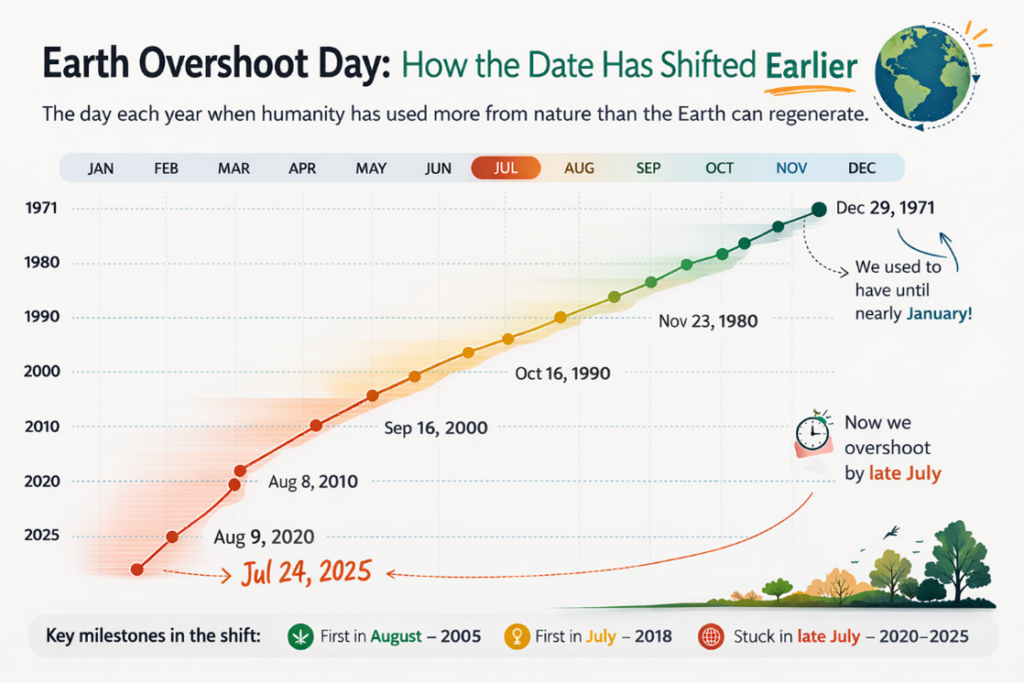
Each year, since 1971, the Global Footprint Network announces the date for Earth Overshoot Day.
Earth Overshoot day marks the date when humanity’s demand for ecological resources and services in a given year exceeds what Earth can regenerate in that year. The day is computed by dividing the planet’s biocapacity (the amount of ecological resources Earth is able to generate that year), by humanity’s Ecological Footprint (humanity’s demand for that year), and multiplying by 365, the number of days in a year.
In 2025, that date was 24 July.
In addition to the global Earth Overshoot Day, the Global Footprint Network also calculates a Country Overshoot Day (16 March for Australia) (Country Overshoot Days 2026). This day complements a country’s deficit day, the day in which the residents of the country begin to demand more than their country’s ecosystem can provide in the entire year.
Country Overshoot Day applies the concept of Earth Overshoot Day at a national level. It estimates the date when humanity would exhaust Earth’s annual ecological resources, if everyone in the world consumed at the same rate as the population of that particular country. The calculation compares a country’s ecological footprint, taking into account factors such as:
- Food production,
- Timber use,
- Urban land,
- Fisheries, and
- Carbon emissions
This comparison is run against the planet’s capacity to regenerate those resources within a year.
Typically, countries with higher per-capita consumption reach their overshoot date earlier in the year, while countries with lower consumption reach it later. As a result, Country Overshoot Day highlights how different lifestyles and economic systems place varying levels of pressure on the planet’s resources.
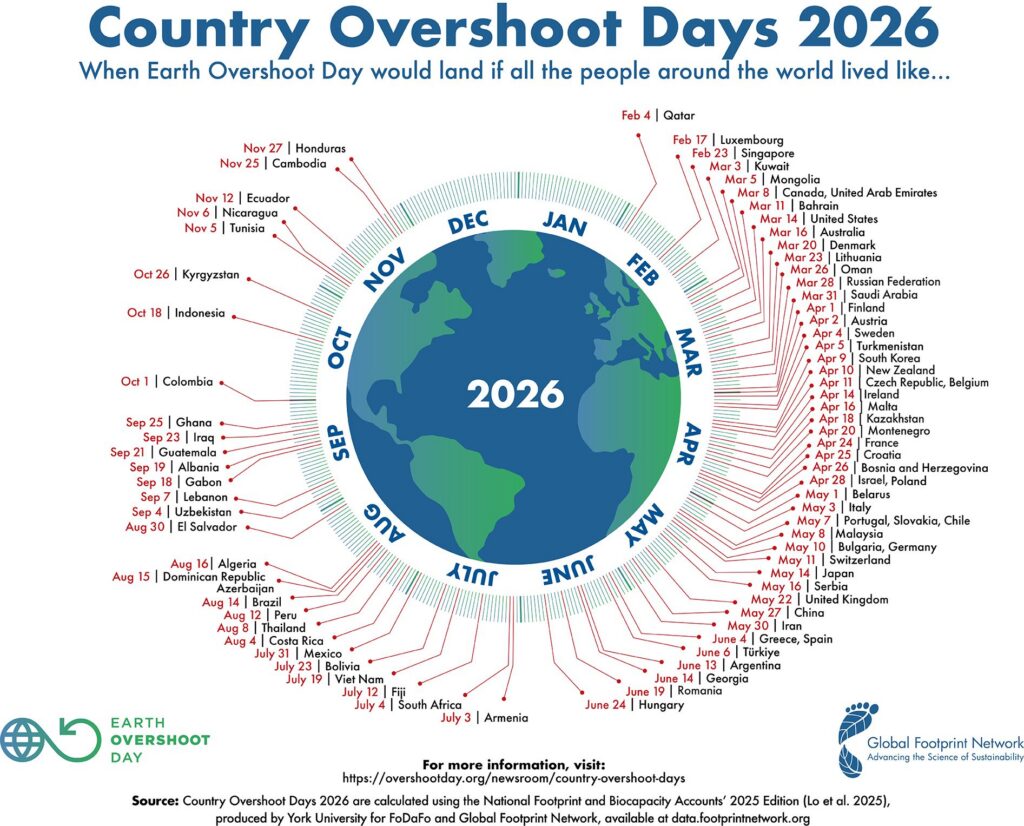
Where Does Australia Sit on the Chart?
If everyone on Earth lived like the average Australian, humanity would have exhausted the planet’s annual ecological resources by 16 March. This means Australia reaches its overshoot date far earlier than the global average, highlighting the country’s relatively large ecological footprint.
Australia is the 10th fastest country to reach its Overshoot Day, sitting only 2 days behind the Unites States of America (Country Overshoot Days 2026).
Australia’s early date is largely driven by high per-capita consumption, carbon-intensive energy systems, and resource-intensive industries.
Continued ecological overshoot contributes to challenges such as climate change, biodiversity loss, land degradation and resource scarcity, all of which have economic and social implications. For businesses and industries that rely on natural resources, these pressures can translate into supply chain risks, regulatory change, rising costs and increasing stakeholder expectations. In this way, Overshoot Day is more than just a symbolic date; it serves as a reminder that current patterns of production and consumption may not be sustainable in the long term.
What Overshoot Means in Practise
When a country reaches its Overshoot Day, it signals that current patterns of consumption and production are using natural resources faster than ecosystems can regenerate them within a year. An overshoot Day as early as 16 March shows the scale of pressure our lifestyles and economy place on the planet’s ecological systems.
This can translate into higher energy use, material consumption and emissions compared with the global norms.
In 2024, CSIRO reported that Australia’s economy uses around four times the amount of raw materials per person compared with the global average (CSIRO 2024). Australia also has one of the highest material consumption rates in the world, using around 38 tonnes per capita each year, compared with the global average of 12 tonnes per capita (Australian Circular Benchmarks).
Australia also has some of the highest carbon emissions per person among developed nations, with roughly 15 tonnes of CO2e per capita, and its electricity consumption is 82.5% higher than the world average Australian Circular Benchmarks. These rates are highly driven by energy production, transport and industrial processes (Australian Carbon Footprint Statistics: Facts & Insights | All Gone Rubbish Removals).
In practice, ecological overshoot can show up as declining biodiversity, land degradation, increased wildfire risk, water stress and climate impacts on communities, farms and infrastructure. It also increases economic and supply chain risks: resource scarcity can drive up costs for businesses, extreme weather events can disrupt operations, and tighter regulations and stakeholder expectations can require faster transitions to sustainable practices.
Moving the Date Back
Understanding Australia’s early Overshoot Day is important, but what can we do about it? The good news is that the date is not fixed. It can shift later in the year if we reduce ecological pressure and adopt more sustainable practices.
So, what can we do to push that date back?
- Expanding Renewable Energies – Move overshoot Day 26 days
Globally, if at least 75% of electricity were generated from renewable sources, Earth Overshoot Day could be delayed by 26 days (Earth Overshoot Day). Currently the global figure is only at 39%.
In Australia, transitioning to renewable energy, improving energy efficiency in homes and businesses, and reducing reliance on fossil fuels can significantly lower the country’s carbon footprint, the largest driver of our early overshoot. - Reduce Food Waste – Move Overshoot Day 13 Days
According to the FAO, 1.3 billion tonnes of edible food is thrown away unnecessarily each year. If we halved food waste worldwide, we could postpone Earth Overshoot Day by 13 days.
In Australia, we waste around 20% of all food produced. Reducing food waste, combined with supporting regenerative agriculture, helps lower pressure on land and water resources, protect soils, and reduce emissions. - Protect Biodiversity – Move Overshoot Day 7 days
Protecting and restoring ecosystems, such as native forests, wetlands, and grasslands, helps absorb carbon, maintain water cycles, and preserve habitats (Project Drawdown 2026). Globally, projects like tropical rainforest restoration could delay overshoot by seven days.
In Australia, conserving native vegetation and restoring degraded land is critical for maintaining biodiversity, supporting wildlife, and keeping ecosystems resilient in the face of climate change. - Sustainable Transport and Urban Planning
Encouraging public transport, active travel and electric vehicles reduces fossil fuel use, while smarter urban design and green infrastructure, like urban green spaces and wildlife corridors, lower energy demand and support biodiversity.
From Individual Actions to Systematic Changes
While actions like renewable energy, reducing food waste and utilising public transport can help push Overshoot Day back, they are most effective when done in parallel with fundamental changes to the way we produce and use resources.
We live in a system that largely follows a linear model: we extract raw materials, turn them into products, use them, and then throw them away. This assumes that resources are unlimited and that waste has no consequences, which isn’t true. A circular, cradle-to-cradle approach offers a better alternative: materials are designed to stay in use as long as possible, reused, refurbished, or recycled, creating a system where waste is minimized and resources continually feed into new products and processes (Science Insights 2026). Composting, for example, returns food and other organic materials back into the soil. Not only helping reduce waste, but composting can also help rejuvenate degraded soils.
To truly move the date further back and protect Australia’s ecosystems, we need to rethink our systems. Designing materials, products and supply chains to stay in circulation, reduce waste and restore natural resources wherever possible.
After 16 March, the air will still feel the same and the trees will still be standing. However, as the days go on, we start borrowing from the future. When calculations began in 1971, Earth Overshoot Day fell on 29 December. Ever since then, that date has been pushed back, further and further, to 24 July in 2025. The implications of the ecological imbalance occurring earlier each year are not just environmental but also economic and social. When ecosystems are under pressure, we feel it too.
Earth Overshoot Day is not just a date on the calendar, but it marks part of a broader conversation about how resources need to be managed in a world that cannot provide endlessly.
You can calculate your ecological footprint here: Ecological Footprint Calculator