
As sustainability expectations continue to grow, businesses of all sizes are feeling greater pressure to align their operations with environmental, social and economic responsibility.
For some organisations, that pressure comes from customers, employees or investors. For others, it may come through tender requirements, supply-chain expectations, changing regulations or a genuine desire to operate more responsibly.
Whether you are just beginning your sustainability journey or looking to strengthen the work already underway, navigating the different priorities and frameworks can feel daunting.
You may know your organisation needs to do more, but working out where to begin is often the hardest part.
At Naturaliste Solutions, we understand the practical challenges businesses face when turning broad sustainability ambitions into meaningful action. From our experience, the strongest sustainability frameworks are not necessarily the most complicated. They are the ones that clearly connect business priorities, stakeholder expectations, governance and measurable action.
This guide breaks the process into practical steps to help you build a business sustainability framework that is realistic, relevant and suited to your organisation.
What Is a Business Sustainability Framework?
A business sustainability framework is a structured approach for identifying sustainability priorities, managing impacts and risks, assigning responsibility and monitoring progress.
It helps an organisation move beyond isolated sustainability initiatives and connect its environmental and social responsibilities with broader business strategy and daily operations.
A practical sustainability framework should help answer questions such as:
- What does sustainability mean for our organisation?
- Which environmental, social and economic issues matter most?
- Where are our most significant positive and negative impacts?
- What risks and opportunities should we address?
- Who is responsible for taking action?
- How will progress be measured and reported?
Your framework does not need to solve every sustainability issue at once. It should provide a clear direction and a practical structure for making steady progress over time.
Start With Vision and Ambition
The foundation of any successful sustainability journey is a clear vision supported by a realistic level of ambition.
Your sustainability vision should come from leadership and align with the core values, purpose and true north of your organisation. It should reflect the type of business you want to become, rather than simply what might sound impressive in a report or on a website.
Without a shared vision, sustainability activities can quickly become disconnected. One team may focus on recycling, another on employee wellbeing and another on carbon emissions, but there may be no common direction linking those efforts.
A clear vision helps employees and decision-makers understand what sustainability means for the organisation and why it matters.
Begin by asking:
- What kind of positive impact do we want to create?
- Which sustainability issues are most closely connected to our operations?
- How should sustainability support our long-term business goals?
- What do we want employees, customers and stakeholders to recognise us for?
- What level of ambition is realistic for our current capacity and resources?
It is also worth reflecting on the positive actions your organisation is already taking.
You may already have energy-efficiency initiatives, waste-reduction processes, employee wellbeing programs, responsible procurement practices or community partnerships in place. These activities should not be overlooked simply because they were not originally described as part of a sustainability strategy.
Recognising what you have already achieved can build confidence and provide a practical foundation for future progress.
You may also consider benchmarking your organisation against businesses that inspire you. Looking at others can help you understand what good practice looks like, but avoid copying another company’s targets without considering whether they are relevant to your own operations, impacts and resources.
Determine Your Strategic Sustainability Priorities
Once you have established your sustainability vision and ambition, the next step is to determine your strategic priorities.
This means aligning sustainability with your existing business strategy and identifying the areas where your organisation can have the most meaningful impact.
A common mistake is trying to address every issue at once. This can stretch resources, create confusion and result in a long list of initiatives that never gain real momentum.
A better approach is to understand where your organisation has the greatest impacts, risks, opportunities and stakeholder expectations.
Conduct a Sustainability Impact Assessment
Begin by assessing your organisation’s sustainability impacts across environmental, social and economic areas.
This assessment does not need to be overly complex, but it should provide an honest overview of your current position, including what you have already achieved and where further work is needed.
Consider both positive and negative impacts.
Positive impacts may include:
- energy-efficiency improvements
- waste-reduction programs
- community engagement
- employee wellbeing initiatives
- workplace safety improvements
- responsible sourcing practices
Acknowledging these achievements can build morale and help identify successful initiatives that may be expanded across the business.
Negative impacts may include:
- greenhouse gas emissions
- high energy or water consumption
- waste generation
- supply-chain labour concerns
- workplace safety issues
- limited workforce diversity
- negative community or biodiversity impacts
This part of the assessment can be uncomfortable, but it is essential. Sustainability progress depends on understanding where harm may be occurring and where the organisation has the ability to improve.
Consider Risks and Opportunities
As you assess your impacts, consider the risks and opportunities associated with each area.
Sustainability should not be treated as separate from business performance. Environmental and social issues may affect operating costs, customer relationships, legal obligations, access to finance, workforce stability and long-term resilience.
Potential risks may include regulatory change, supply-chain disruption, reputational damage, rising energy costs or failure to meet customer and tender requirements.
At the same time, sustainability may create opportunities for innovation, cost savings, stronger employee engagement, improved tender competitiveness and more resilient business models.
For each priority area, ask:
- What could happen if we do nothing?
- What could improve if we take action?
- Which issues require immediate attention?
- Where could sustainability create operational or commercial value?
By considering both risks and opportunities, you can develop a sustainability strategy that supports responsible decision-making rather than operating as a separate communications exercise.
Identify Easy Wins and Longer-Term Actions
Once you understand your priorities, identify some practical easy wins that can build early momentum.
These may include improving waste separation, reviewing energy use, reducing unnecessary printing, updating procurement criteria, introducing employee training or beginning to collect baseline sustainability data.
Easy wins are useful, but they should not become the entire strategy.
Some of your most important priorities may involve longer-term work, such as reducing emissions, changing suppliers, improving workforce diversity or investing in better data systems.
A strong sustainability framework should therefore include both short-term actions and longer-term commitments.
Align With Stakeholder Expectations
Stakeholder engagement is an important part of building a credible sustainability framework.
Your stakeholders may include employees, customers, suppliers, investors, community members, regulators, industry bodies and government agencies.
Engaging with these groups can help you understand which sustainability issues matter most to them and whether your priorities reflect the expectations of the people affected by your business.
Stakeholder engagement may involve surveys, interviews, workshops, customer feedback, supplier discussions or employee consultation.
This does not mean every stakeholder request must automatically become a strategic priority. However, their feedback may reveal risks, concerns or opportunities that are not immediately visible within the organisation.
Do Not Underestimate Your Employees
Employees can be one of your most valuable sustainability resources.
They often understand operational challenges, inefficient processes and practical opportunities in ways that senior leadership may not.
Some employees may also bring relevant experience or a genuine passion for sustainability.
Ask them what sustainability issues they notice in their work, which processes create unnecessary waste and what support would help them contribute.
People are more likely to support change when they feel involved in shaping it.

Build Strong Sustainability Governance
Strong governance is essential for turning sustainability priorities into action.
Once you have identified your priorities, you need clear roles, responsibilities and decision-making processes to support them.
Without strong governance, good intentions can become stuck between departments, delayed by competing priorities or forgotten when key employees leave.
A sustainability governance framework may include:
- Board or executive oversight
- defined roles and responsibilities
- relevant policies and procedures
- sustainability action plans
- performance measures
- regular progress reporting
Begin by reviewing your existing governance arrangements. You may already have policies, committees or risk-management processes that can be expanded to include sustainability.
Consider who approves the sustainability strategy, who is accountable for each priority, who collects the data and how often progress will be reviewed.
Sustainability works best when it is integrated across the organisation rather than assigned entirely to one person or team.
Finance, operations, procurement, human resources, risk and communications may all have important responsibilities.
Embedding sustainability takes time. Every policy does not need to be perfect from day one, but ownership and decision-making processes should be clear enough to support action.
Report on Sustainability Progress
With your strategy and governance in place, it is time to monitor and report on progress.
Sustainability reporting is not simply about producing a polished annual document. It helps the organisation understand whether its actions are working and where improvement is still required.
Regular reporting can help:
- track sustainability performance
- identify trends and gaps
- support better decision-making
- build trust with stakeholders
- respond to regulatory, tender or customer requirements
Transparent reporting should communicate both achievements and challenges.
Stakeholders are increasingly cautious about vague sustainability claims. They want to understand what the organisation has done, what evidence supports those claims and what still needs to improve.
Begin With the Data You Have
Start by gathering both quantitative and qualitative information.
Quantitative data may include energy use, emissions, water consumption, waste, workforce information or safety performance.
Qualitative information may include case studies, stakeholder feedback, policy improvements and descriptions of new initiatives.
You may not have every piece of information available during your first reporting cycle. That is common.
The important thing is to be honest about data limitations and create a realistic plan to improve your datasets over time.
Reliable data is more valuable than impressive-looking information that cannot be supported.
You should also consider relevant sustainability frameworks and standards when developing your reporting approach. The framework selected should suit your organisation’s size, industry, stakeholders and reporting purpose.
Review and Improve Your Sustainability Framework
A sustainability framework should not remain static.
Your organisation, industry and stakeholder expectations will continue to change, so your approach should evolve alongside them.
Review your framework regularly and consider:
- Are our priorities still relevant?
- Are we making progress against our goals?
- Is our governance structure working?
- Do employees understand their responsibilities?
- Is our sustainability data reliable?
- Have new risks or opportunities emerged?
Sustainability progress is rarely perfectly linear. Some initiatives will work well, while others may require more time, investment or a different approach.
Regular review helps your organisation learn from experience and strengthen its sustainability framework over time.
Business Sustainability Framework Overview
A practical business sustainability framework will generally include:
- A clear sustainability vision and level of ambition.
- An assessment of positive and negative impacts.
- Identification of sustainability risks and opportunities.
- Strategic priorities aligned with business goals.
- Meaningful stakeholder engagement.
- Defined governance and accountability.
- Measurable goals and action plans.
- Reliable performance data.
- Regular monitoring and reporting.
- Ongoing review and improvement.
Ready to Take the Next Step in Your Sustainability Journey?
Building a sustainability framework can feel complicated, but it becomes far more manageable when the process is broken into practical stages.
Start with a clear vision. Understand your impacts. Identify strategic priorities. Engage stakeholders. Build strong governance and report honestly on progress.
You do not need to solve every sustainability issue immediately. You do need a clear direction, realistic priorities and a structure that turns intention into action.
Naturaliste Solutions’ Fast Track program provides practical guidance and support to help businesses build their sustainability framework.
From conducting sustainability impact assessments and setting strategic priorities to engaging stakeholders and strengthening governance, the program provides the support needed to move forward with confidence.
Download the Business Sustainability Framework
Use the Naturaliste Solutions Business Sustainability Framework Overview as a practical reference when planning your organisation’s next steps.
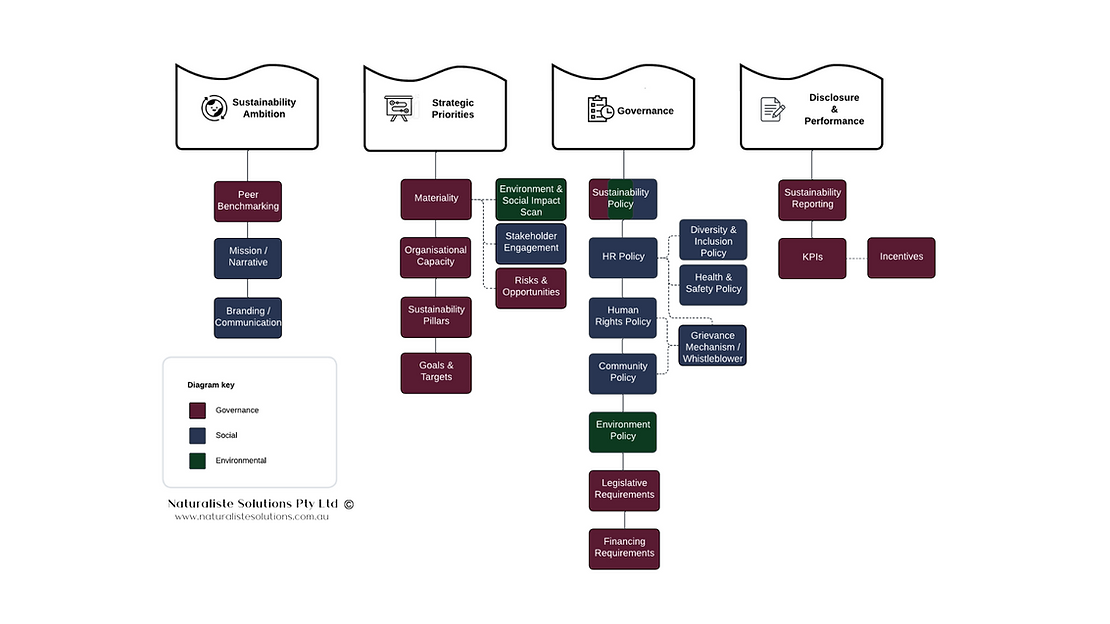
Download the Business Sustainability Framework PDF
Frequently Asked Questions
What is a business sustainability framework?
A business sustainability framework is a structured approach for identifying sustainability priorities, managing impacts and risks, assigning responsibility and measuring progress.
Where should a business begin its sustainability journey?
Begin by defining what sustainability means for the organisation, reviewing existing initiatives and assessing positive and negative impacts across operations and the value chain.
Why is stakeholder engagement important in sustainability?
Stakeholder engagement helps organisations understand expectations, identify emerging concerns and make better-informed decisions.
What does sustainability governance include?
Sustainability governance may include Board oversight, executive accountability, policies, responsibilities, action plans, performance measures and regular reporting.
Does a business need complete data before reporting on sustainability?
No. Many organisations begin with incomplete information. The important thing is to acknowledge limitations and establish a clear plan for improving data quality over time.
This article provides general information and does not constitute legal, financial or regulatory advice. Sustainability and reporting requirements may vary depending on the organisation, industry and applicable obligations.